



Posted in أنظمة الري, إدارة مياه الري on نوفمبر 04, 2026
Drip Irrigation for Newly Planted Trees

Drip Irrigation Scheduling for Newly Planted Trees in Saudi Arabia
Newly planted trees in Saudi Arabia can fail even when a drip irrigation system is installed correctly. The problem is often not the presence or absence of irrigation equipment, but the schedule used after planting. A timer may run every day, yet the root ball remains partly dry. Another tree may receive the same schedule while sitting in heavier soil that remains saturated for too long. Both trees are being “irrigated,” but neither is necessarily being irrigated correctly.
A newly planted tree has a limited root system concentrated inside the nursery root ball. It cannot immediately use the surrounding soil volume in the same way as an established tree. This makes the first weeks and months after planting especially sensitive. The irrigation schedule must keep the active root zone adequately moist while still allowing air to remain in the soil and encouraging roots to expand beyond the original root ball.
In Saudi conditions, irrigation demand can change rapidly because of heat, dry air, wind, reflected heat from paving and buildings, soil type, tree size, planting season, and irrigation-water quality. This is why a schedule that works for one project should not automatically be copied to another site.
This guide explains how to schedule drip irrigation for newly planted trees using water quantity, emitter flow, runtime, soil moisture, irrigation timing, monitoring, and gradual schedule adjustment. It focuses specifically on the establishment period after planting rather than repeating broader topics such as planting seasons, fruit trees, tree asset registers, or protecting trees during construction.
 Call Now
 WhatsApp
Do not schedule newly planted trees only by calendar. Start with a frequent establishment schedule, then verify the moisture inside the root ball and surrounding soil before every adjustment. The correct interval becomes longer as roots expand, but the transition should be based on observation rather than a fixed date alone.
Calculate delivered water from emitter flow × number of emitters × runtime. For example, if two emitters each deliver 4 liters per hour and run for one hour, the theoretical delivered volume is 8 liters. This calculation tells you what the irrigation system is applying; soil inspection tells you whether that amount is actually appropriate.
Newly planted trees should initially receive water directly across the nursery root ball and its immediate edge. As roots establish, emitter placement and the wetted area should gradually expand outward instead of keeping all water permanently next to the trunk.
The main objective is not “more water.” It is consistent root-zone moisture without prolonged saturation, runoff, emitter clogging, or repeated shallow wetting that keeps roots concentrated in a very small area.
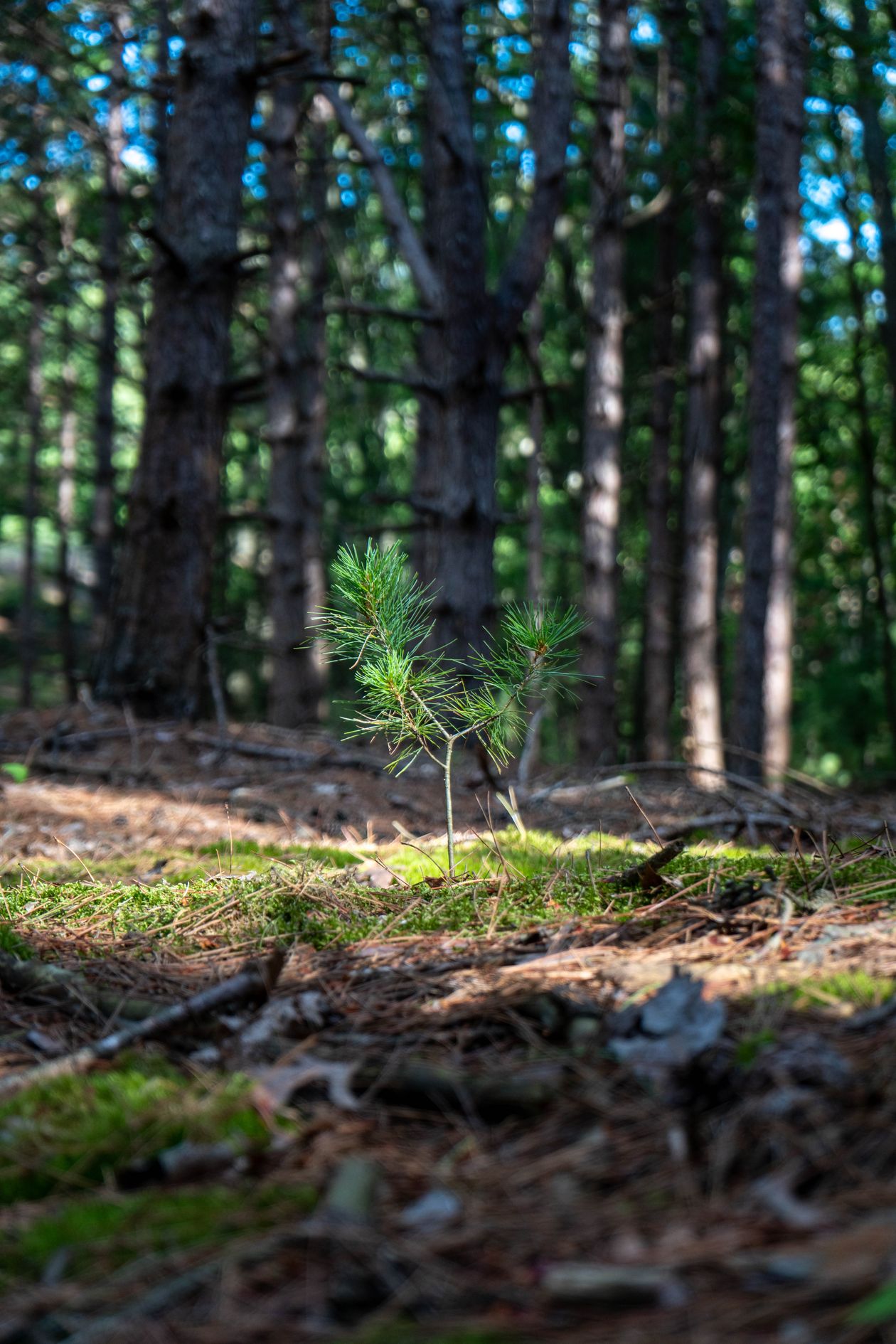
Why is irrigation for newly planted trees different from established-tree irrigation?
A nursery tree arrives with most of its active roots contained inside a relatively compact root ball. Once planted, the tree may have a large canopy above ground but only a small volume of roots capable of absorbing water effectively.
An established tree can draw water from a much wider soil volume. A newly planted tree cannot. This creates a temporary imbalance between the canopy losing water and the limited roots supplying it.
The establishment schedule must therefore maintain relatively consistent moisture around the original root system while encouraging new roots to enter the surrounding soil.
Irrigation that is too infrequent can allow the root ball to dry before roots have expanded. Irrigation that is excessively frequent can keep the planting hole saturated, reducing oxygen around the roots.
What is the root ball and why should irrigation start there?
The root ball is the soil and root mass that comes with the tree from the nursery container, box, bag, or field-growing system.
Immediately after planting, this is where most water-absorbing roots are located.
If emitters are placed far away from the root ball on the first day, the surrounding soil may become wet while the actual nursery root mass remains too dry.
Initial emitter placement should therefore wet the root ball and its immediate edge. As new roots grow outward, the irrigation pattern should expand accordingly.
What should a newly planted tree irrigation schedule achieve?
The schedule has four main objectives.
First, prevent the root ball from drying severely during the establishment period.
Second, avoid keeping the planting hole continuously saturated.
Third, create a gradually widening moist soil volume that encourages root expansion.
Fourth, reduce irrigation frequency progressively as the tree becomes more established without suddenly removing the water supply.
Which factors determine irrigation frequency and water volume?
There is no single schedule for every newly planted tree.
Important variables include tree species, nursery stock size, root-ball dimensions, soil texture, soil depth, drainage, planting season, temperature, wind, shade, surrounding paving, irrigation-water quality, emitter flow, number of emitters, and maintenance quality.
The same tree planted in a shaded landscape bed can require a different schedule from the same tree planted beside a large paved parking area.
The schedule must therefore be treated as a controlled field decision rather than a permanent timer setting.
How does soil texture change drip irrigation scheduling?
Sandy soil generally drains faster and allows water to move downward relatively quickly. This can require shorter intervals between irrigation events and a wider distribution of emitters to wet enough soil around the root zone.
Heavier clay soil holds water longer and often spreads moisture laterally, but poor drainage can create prolonged saturation if irrigation is applied too frequently.
Loam generally behaves between these extremes.
This is why runtime should not be copied from another site without checking what the water actually does in the soil.
| Soil Condition | Typical Water Behavior | Scheduling Concern | Field Check |
|---|---|---|---|
| Sandy | Faster downward movement | Root ball may dry faster | Check moisture at several depths |
| Loam | Balanced movement | Avoid fixed assumptions | Inspect root ball and surrounding soil |
| Clay / Compacted | Slower drainage and more lateral spread | Waterlogging | Check before every additional cycle |
How does nursery tree size affect irrigation?
Larger nursery stock generally has a larger canopy and root ball and therefore a larger immediate water requirement than a small tree.
However, tree size should not be translated into a universal liters-per-day rule without considering species, root-ball dimensions, soil, weather, and irrigation efficiency.
The useful operational approach is to estimate an initial water volume, apply it through known emitter flow, and inspect the soil profile afterward.
If only the upper few centimeters are moist, the runtime may be too short. If the planting hole remains saturated for long periods, the volume or frequency may be excessive or drainage may be poor.
How does Saudi weather change the irrigation schedule?
High temperature increases evaporative demand, while hot dry wind can increase water loss from foliage and soil.
Newly planted trees can therefore move from acceptable moisture to stress faster during hot periods than during cooler months.
This does not mean the controller should simply be set to maximum irrigation throughout summer. Soil drainage still matters, and overwatering can remain harmful even in hot weather.
The schedule should be checked more frequently during major weather changes rather than adjusted only by season name.
Why can trees on the same project require different schedules?
A project contains several microclimates.
A tree beside asphalt or a south-facing wall may receive more reflected heat than a tree inside a shaded garden bed.
A tree exposed to continuous wind may lose water faster than one protected by buildings.
Low areas may drain differently from raised planting beds.
The irrigation system should therefore allow trees with genuinely different conditions to be managed separately when the project scale justifies it.

How do you determine how much water a newly planted tree receives?
The first step is to calculate what the irrigation hardware actually delivers.
Use this simple relationship:
Water delivered=emitter flow rate × number of emitters × runtime
If a tree has two emitters rated at 4 liters per hour and the zone runs for 45 minutes, the theoretical delivered amount is 6 liters.
If four emitters rated at 8 liters per hour run for 30 minutes, the theoretical amount is 16 liters.
These examples explain the calculation method; they are not universal recommendations for tree water demand.
After calculating delivery, inspect the moisture pattern to determine whether the volume wets the required root zone without creating prolonged saturation or runoff.
How do you convert a required volume into irrigation runtime?
If you already have a target test volume, divide that volume by the total emitter flow serving the tree.
For example, if the total emitter flow around a tree is 8 liters per hour and you want to test an 8-liter irrigation event, the theoretical runtime is one hour.
If the total flow is 16 liters per hour, the same 8-liter event would require 30 minutes.
This calculation is extremely useful because different projects may use different emitters. A controller time such as “30 minutes” means very little unless you know the actual flow connected to each tree.
| Emitters | Flow per Emitter | Runtime | Theoretical Delivery |
|---|---|---|---|
| 2 | 4 L/h | 45 min | 6 L |
| 2 | 4 L/h | 60 min | 8 L |
| 4 | 4 L/h | 60 min | 16 L |
| 4 | 8 L/h | 30 min | 16 L |
How many emitters should a newly planted tree have?
The answer depends on root-ball size, soil texture, emitter flow, and the area that must be wetted.
One high-flow emitter beside the trunk may deliver enough liters mathematically but still wet only a narrow column of soil.
Several lower-flow emitters distributed around the root ball can create a more balanced wetting pattern.
Sandy soils may require more distribution points because lateral water movement can be limited, while heavier soils may spread water further sideways.
As the tree grows, the system should be able to add emitters or reposition them outward.
Where should drip emitters be placed around a newly planted tree?
During early establishment, emitters should be positioned so water reaches the root ball and the interface between the nursery soil and surrounding site soil.
Avoid keeping all emitters directly against the trunk.
The target is the active root zone, not the bark.
As roots expand, emitters should gradually move outward and additional emitters may be added so the wetted soil area expands with the developing root system.
A permanent tiny wet spot beside the trunk can limit the effective root zone even if total liters appear adequate.
How should irrigation be managed immediately after planting?
The first objective is to ensure the root ball and surrounding planting soil are properly wetted after installation.
Then the maintenance team should inspect moisture frequently because recently planted trees can dry quickly before roots establish.
During the earliest establishment period, irrigation is generally more frequent than it will be later.
However, the team should still check soil moisture rather than automatically adding water to a planting hole that remains saturated.
How should the first weeks after planting be managed?
Early establishment typically requires frequent attention because new roots have not yet moved far into the surrounding soil.
A useful starting framework is to monitor daily during the first stage, then gradually test longer intervals as the tree stabilizes.
International extension guidance commonly uses a progression from very frequent irrigation immediately after planting toward irrigation every few days and later toward wider intervals as roots establish.
In Saudi projects, that progression must be adjusted according to actual heat, soil drainage, planting season, tree size, and microclimate rather than copied literally.
How do you know when to extend the interval between irrigation events?
Do not extend the interval simply because a specific number of days has passed.
Check whether the root ball is retaining adequate moisture longer than before, whether new growth appears stable, and whether the surrounding soil is becoming part of the active wetted root zone.
Extend the interval gradually and monitor the tree after the change.
If the tree shows repeated stress before the next irrigation event, the interval may have been extended too quickly.
What time of day is practical for drip irrigation?
Early morning is often operationally convenient because temperatures are lower and the maintenance team can inspect the system afterward.
With drip irrigation, evaporation losses are already lower than with broad overhead irrigation because water is applied directly to a limited soil area.
Avoid using time of day as a substitute for correct scheduling. A poorly calculated irrigation event remains poor even if it occurs at the “right” hour.
The main priorities are correct volume, correct frequency, functioning emitters, and suitable soil moisture.
How do you monitor soil moisture around newly planted trees?
Use a soil probe, hand inspection, auger, moisture sensor, or another practical field method appropriate to the project.
Inspect below the soil surface. The top may look dry while deeper soil remains wet.
Check more than one point because drip irrigation creates localized wetting patterns.
Compare moisture inside the original root ball, immediately outside it, and farther into the surrounding soil.
This gives a much better picture than simply checking whether the emitter is dripping.
Why should you compare moisture inside the root ball and surrounding backfill?
Nursery growing media and site soil can behave differently.
The root ball may dry while surrounding heavier soil remains wet, or the reverse can occur.
If the maintenance team checks only the surrounding soil, it may assume the tree has enough water even though the active roots remain dry.
This comparison is especially important during the early establishment period before the roots have crossed strongly into the surrounding soil.
When are soil-moisture sensors useful?
Sensors are useful on larger projects, high-value landscapes, sites with variable soil, and projects where irrigation performance needs to be documented.
They can show how quickly moisture decreases between irrigation events and whether the soil remains wet for too long.
Sensor placement matters. A sensor outside the active wetting zone can give misleading information.
Sensors should support field inspection rather than completely replace it, especially during commissioning and early establishment.
What are possible signs that a newly planted tree is receiving too little water?
Repeated loss of leaf firmness, premature leaf drop, drying leaf edges, weak new growth, or canopy dieback may indicate water stress.
However, these symptoms are not specific to underwatering. Root damage, salinity, poor planting, heat injury, pests, and overwatering can sometimes produce similar visible stress.
Always inspect soil moisture and the irrigation system before increasing water based only on canopy appearance.
What are possible signs of overwatering or poor drainage?
Soil that remains wet for long periods, standing water in the basin, weak root-zone aeration, declining foliage despite constant irrigation, and persistent soft saturated soil can indicate excessive irrigation or poor drainage.
The solution is not automatically to reduce liters without investigation.
Check whether the planting hole drains, whether irrigation frequency is too high, whether emitters are leaking, and whether another irrigation zone is also wetting the tree.
Newly planted trees require moisture, but their roots also require oxygen.
| Observation | Possible Cause | What to Inspect | Avoid |
|---|---|---|---|
| Root ball dry | Low volume / poor placement | Emitter flow and wetting pattern | Increasing every zone blindly |
| Soil constantly saturated | High frequency / drainage issue | Drainage and controller schedule | Assuming heat prevents overwatering |
| One side dry | Uneven emitter placement | Emitter distribution | Adding runtime only |
| Tree stressed but soil wet | Possible non-irrigation issue | Roots, salinity, planting, drainage | Automatically adding more water |
How does irrigation-water salinity affect newly planted tree management?
Water quality can affect root performance and soil conditions over time.
Where irrigation water or soil contains elevated salts, the project may require specific irrigation, drainage, monitoring, and species-selection strategies.
Do not respond to suspected salinity simply by increasing irrigation frequency without understanding the water analysis, soil drainage, and landscape specification.
Larger projects should use laboratory water and soil information when salinity is a known concern.
How does mulch change the irrigation schedule?
Organic mulch can reduce direct soil evaporation and moderate soil temperature.
This can help root-zone moisture remain more stable between irrigation events.
Keep mulch away from direct contact with the trunk base rather than piling it against the bark.
After mulch is added or changed, monitor the soil because the old irrigation schedule may now keep the soil wet for longer.
How should irrigation controllers be programmed for newly planted trees?
The controller should make it easy to adjust runtime and frequency independently.
Newly planted trees should not be permanently locked into the same schedule as established trees if their requirements are different.
Record the emitter flow and number of emitters associated with each design type so controller runtime can be translated into actual delivered water.
When schedule changes are made, document the date and reason so later performance can be evaluated.
Why should different plant types and establishment stages be separated into irrigation zones?
A newly planted tree should not necessarily operate on the same schedule as turf, shrubs, established trees, or groundcover.
These plants have different root systems, irrigation frequencies, and emitter or sprinkler characteristics.
Combining very different water requirements on the same valve often forces the maintenance team to overwater one group in order to satisfy another.
Separate zones provide better control and make seasonal adjustment easier.
Need a practical irrigation schedule for newly planted trees, including emitter flow, runtime, soil checks, and establishment monitoring?
How should the drip irrigation system itself be maintained?
A perfect schedule is useless if emitters are clogged or pressure is inconsistent.
Inspect emitters visually, check filters, flush lines when required, and verify that flow reaches every tree.
Look for damaged tubing, disconnected emitters, crushed lines, leakage, and emitters buried or moved away from the intended root zone.
Pressure regulation is important because emitter performance can change when operating pressure is outside the intended range.
Maintenance teams should periodically compare actual emitter discharge with the nominal flow rate rather than assuming every emitter still performs as specified.
How should the schedule change between hot and cooler periods?
During hotter conditions, soil moisture may decline faster and the maintenance team may need to shorten intervals or adjust delivered volume.
During cooler conditions, the same program may leave the soil wet for much longer.
Avoid making seasonal changes by percentage alone without checking field moisture.
The controller can provide the adjustment, but the soil should confirm whether that adjustment is correct.
What should be recorded for newly planted tree irrigation?
Record the planting date, tree identification, species, nursery size, irrigation zone, emitter count, emitter flow, controller runtime, irrigation frequency, and notable soil conditions.
Record changes in the schedule and why they were made.
Add observations such as clogged emitters, root-ball dryness, prolonged wetness, canopy stress, or successful interval extension.
This turns irrigation from a memory-based maintenance task into a manageable operational system.
How do you troubleshoot a newly planted tree that appears poorly irrigated?
First, confirm that the controller actually operated.
Second, inspect the emitter and measure or verify flow.
Third, inspect root-ball moisture and surrounding soil moisture separately.
Fourth, confirm that water is entering the intended root zone rather than running away from it.
Fifth, review drainage.
Sixth, review other possible causes of stress such as planting depth, root damage, salinity, heat exposure, or pest problems.
Do not solve every stressed-tree problem by increasing irrigation time.
What affects the cost of managing drip irrigation for newly planted trees?
The number of trees is one factor, but project complexity also matters.
Separate irrigation zones, pressure regulation, filtration, controller capability, soil-moisture sensors, emitter count, water analysis, inspection frequency, and maintenance access all influence project cost.
A larger initial investment in controllable zones and accessible components can reduce maintenance problems later.
The cheapest system at installation may become expensive if hundreds of trees receive unsuitable water because the design cannot be adjusted accurately.
| Management Component | Why It Matters | Low-Control Risk | Better Practice |
|---|---|---|---|
| Separate Zones | Different water needs | Over/under irrigation | Group similar trees and conditions |
| Filtration | Protects emitters | Clogging | Accessible filter maintenance |
| Flow Records | Links runtime to liters | Unknown actual volume | Document emitter specification |
| Moisture Monitoring | Validates schedule | Calendar-only irrigation | Regular field checks |
What are the most common mistakes when irrigating newly planted trees?
The first mistake is giving every newly planted tree the same fixed schedule regardless of species, size, soil, or location.
The second mistake is scheduling by minutes without knowing emitter flow.
The third mistake is assuming a dripping emitter means the entire root ball is wet.
The fourth mistake is placing all emitters directly against the trunk.
The fifth mistake is allowing the root ball to dry while surrounding soil remains wet.
The sixth mistake is applying water again while heavy soil is still saturated.
The seventh mistake is increasing water every time foliage looks stressed without checking soil moisture.
The eighth mistake is keeping newly planted and established trees permanently on the same irrigation program.
The ninth mistake is running trees on the same zone as turf with completely different scheduling needs.
The tenth mistake is failing to expand emitter placement outward as roots grow.
The eleventh mistake is using too few emitters to create a useful wetted soil volume.
The twelfth mistake is ignoring clogged emitters.
The thirteenth mistake is not maintaining filters.
The fourteenth mistake is allowing pressure problems to change emitter performance.
The fifteenth mistake is leaving the same schedule unchanged through major seasonal weather changes.
The sixteenth mistake is ignoring reflected heat from paving and walls.
The seventeenth mistake is ignoring poor drainage because the weather is hot.
The eighteenth mistake is assuming drought-tolerant species need little irrigation immediately after planting.
The nineteenth mistake is failing to record schedule changes.
The twentieth mistake is judging irrigation success only from the controller rather than from the soil and tree.
What is the field checklist for newly planted tree drip irrigation?
Tree Information:
☐ Species is recorded.
☐ Planting date is recorded.
☐ Nursery stock size is recorded.
☐ Root-ball dimensions are understood.
Site Conditions:
☐ Soil texture is checked.
☐ Drainage is checked.
☐ Sun exposure is known.
☐ Reflected heat is considered.
☐ Wind exposure is considered.
Drip System:
☐ Emitter type is known.
☐ Flow rate is known.
☐ Number of emitters is known.
☐ Filter is clean.
☐ Pressure is appropriate.
☐ Lines are not damaged.
Emitter Placement:
☐ Root ball is being wetted.
☐ Emitters are not concentrated against the trunk.
☐ Water reaches the root-ball edge.
☐ Placement can expand outward later.
Scheduling:
☐ Frequency matches establishment stage.
☐ Runtime is converted to actual liters.
☐ Schedule is reviewed after weather changes.
☐ Schedule is adjusted gradually.
Moisture Monitoring:
☐ Root ball is checked.
☐ Surrounding soil is checked.
☐ More than one depth is checked.
☐ Saturation is not persistent.
Tree Response:
☐ Canopy condition is observed.
☐ New growth is monitored.
☐ Stress symptoms are recorded.
☐ Irrigation is not blamed for every symptom automatically.
Maintenance:
☐ Emitters are inspected.
☐ Filters are serviced.
☐ Lines are flushed when required.
☐ Leaks are corrected.
☐ Flow performance is verified.
Records:
☐ Controller settings are documented.
☐ Schedule changes are dated.
☐ Field observations are recorded.
☐ Establishment progress is reviewed.
How does irrigation scheduling differ across practical Saudi landscape scenarios?
New Tree Beside a Large Paved Parking Area
Reflected heat and high surface temperatures can increase stress around the canopy and soil surface.
Monitor moisture more frequently during hot periods and make sure the planting basin is not receiving additional runoff or heat from surrounding paving.
New Tree in Heavy Clay Soil
Frequent irrigation can become dangerous if the planting hole drains slowly.
Inspect the deeper soil before adding another cycle and distinguish between heat stress and waterlogging symptoms.
New Tree in Sandy Soil
Water may move downward quickly and create a narrow wetting pattern.
Emitter distribution becomes particularly important, and the interval may require closer monitoring during hot conditions.
Large Transplanted Nursery Tree
A larger root ball and canopy require more careful water-volume planning than a small nursery tree.
Do not assume one or two small emitters are sufficient simply because water is visible at the soil surface.
New Trees Along a Road or Long Landscape Corridor
Pressure variation along long lines may cause trees near one end of the zone to receive different flow from trees elsewhere.
Check operating pressure and actual emitter discharge at representative locations.
Mixed Project with Newly Planted and Established Trees
The trees should not automatically share identical runtimes and frequencies.
Use separate zones or another controllable strategy where possible so establishment irrigation can be reduced gradually without compromising established planting.
| Scenario | Main Risk | Monitoring Priority | Management Focus |
|---|---|---|---|
| Hot paved area | Rapid drying / heat stress | Root-ball moisture | Frequent observation |
| Heavy soil | Waterlogging | Deep moisture and drainage | Avoid excessive frequency |
| Sandy soil | Narrow/rapid wetting | Wetting pattern | Emitter distribution |
| Long irrigation line | Pressure variation | Actual emitter flow | Hydraulic balance |
What are the most common questions about drip irrigation scheduling for newly planted trees?
1. Should newly planted trees be irrigated every day?
Very frequent irrigation is common immediately after planting, but the schedule should be adjusted according to soil moisture, drainage, weather, root-ball size, and establishment progress rather than continued automatically.
2. How many liters does a newly planted tree need?
There is no single volume suitable for all trees. Tree size, root-ball dimensions, soil, weather, species, and emitter distribution all affect the requirement. Calculate delivered water from flow and runtime, then validate it in the soil.
3. How do I calculate liters from a drip system?
Multiply the flow rate of one emitter by the number of emitters and the operating time in hours.
4. Is a longer runtime always better than frequent short cycles?
Not automatically. The correct strategy depends on soil infiltration, root-ball moisture, drainage, and the required wetting depth.
5. Why is the topsoil dry even after irrigation?
Surface appearance can be misleading. Drip irrigation may wet deeper soil while leaving part of the surface dry, so inspect at root-zone depth.
6. Why is the surrounding soil wet but the tree still stressed?
The nursery root ball may remain dry, or the problem may involve drainage, salinity, roots, planting depth, or another non-irrigation issue.
7. Should emitters be next to the trunk?
Water should target the active root zone rather than the bark. During establishment, place emitters across the root-ball area and edge rather than concentrating them against the trunk.
8. When should emitters be moved outward?
As the tree establishes and roots expand into surrounding soil, gradually expand the wetted area and reposition or add emitters as needed.
9. Can newly planted trees use the same irrigation zone as turf?
It is generally difficult because turf and newly planted trees usually require different application methods and scheduling patterns.
10. Does a drought-tolerant tree need little water immediately after planting?
No. Drought tolerance after establishment does not mean the newly planted root ball can be allowed to dry severely during establishment.
11. How do I know whether clay soil is receiving too much water?
Inspect moisture below the surface and determine whether the planting zone remains saturated for prolonged periods before the next scheduled irrigation.
12. How often should emitters be inspected?
They should be checked routinely, with more frequent attention during establishment and whenever tree performance suggests uneven water delivery.
13. Why do some trees on the same irrigation zone perform differently?
Differences in soil, shade, reflected heat, wind exposure, root-ball condition, emitter flow, and drainage can create different moisture conditions even under one controller schedule.
14. Can soil-moisture sensors replace manual inspection?
They are useful management tools, especially on larger projects, but sensor location and interpretation matter. Field inspection remains valuable.
15. Should the irrigation schedule stay the same all summer?
No. Weather and establishment progress change, so irrigation should be reviewed rather than left unchanged for an entire season.
16. Why does a tree decline even though irrigation runs every day?
Daily operation does not guarantee correct irrigation. The root ball may receive too little water, too much water, uneven water, or the problem may come from drainage, salinity, planting, or root damage.
17. How can I tell if an emitter is clogged?
Observe discharge, compare with similar emitters, inspect the wetting pattern, and measure flow where necessary.
18. Does mulch mean I should irrigate less?
Mulch can reduce evaporation and keep soil moist longer, but schedule changes should be based on actual moisture observations rather than automatic assumptions.
19. When can the irrigation interval become longer?
As roots establish and the root zone holds adequate moisture for longer periods, intervals can be expanded gradually while monitoring tree response.
20. What information is needed to create a tree irrigation schedule?
Tree species and size, planting date, root-ball dimensions, soil type, drainage, microclimate, water quality where relevant, emitter number and flow, controller capacity, planting season, and field moisture observations.
What is the final approach to drip irrigation scheduling for newly planted trees?
Start with the tree and root ball, not the controller.
Know the soil texture and drainage before deciding irrigation frequency.
Treat newly planted trees differently from established trees.
Calculate the water delivered from emitter flow, emitter count, and runtime.
Do not use controller minutes as a substitute for liters.
Place emitters so the initial root ball receives water.
Expand the wetting pattern gradually as roots establish.
Monitor the root ball and surrounding soil separately.
Use more than one inspection depth.
Adjust irrigation more frequently during major weather changes.
Do not assume summer heat makes overwatering impossible.
Do not assume drought-tolerant species are drought-tolerant immediately after planting.
Use soil-moisture sensors when project scale and value justify them.
Keep filters, pressure regulation, tubing, and emitters in working condition.
Separate trees from turf or other plant groups when their irrigation needs are substantially different.
Record every major controller change so irrigation performance can be reviewed later.
When a tree declines, inspect the irrigation system and soil before simply adding more water.
Extend the interval gradually as establishment improves.
Manage each site according to soil, climate, tree size, microclimate, and actual root-zone moisture rather than copying another project's timer settings.
At Rayat Najd Landscaping & Sustainability, newly planted tree irrigation is approached as a monitored establishment process that combines tree condition, root-ball moisture, soil behavior, emitter flow, runtime, weather, and system maintenance. The objective is to deliver water where developing roots can use it while progressively expanding the wetted root zone and reducing unnecessary irrigation as the tree becomes established.
This post is part of a series called Post