



Posted in الأشجار المتحملة للجفاف, تنسيق الحدائق في الرياض on نوفمبر 05, 2026
Drought-Tolerant Trees for Riyadh Landscaping

How to Select Drought- and Heat-Tolerant Trees for Riyadh Landscaping
Choosing trees for a landscaping project in Riyadh is not simply a matter of selecting the species that looks best in a nursery. A tree may appear healthy under controlled nursery irrigation yet struggle after installation when exposed to intense summer heat, dry air, reflective paving, limited rooting volume, saline irrigation water, compacted soil, wind, and long periods between irrigation cycles.
For this reason, drought tolerance should not be treated as a marketing label. A suitable tree must match the site's climate, soil, irrigation-water quality, available rooting space, intended function, mature size, maintenance capacity, and surrounding hardscape. The correct question is not simply, “Which tree survives heat?” but rather, “Which tree can perform reliably in this specific landscape with a realistic level of water and maintenance?”
A successful Riyadh landscape often combines regionally adapted trees with carefully selected non-native species where appropriate, while prioritizing trees capable of establishing deep or effective root systems, tolerating high temperatures, recovering from water stress, and maintaining acceptable form without constant intervention.
This guide explains how to select drought- and heat-tolerant trees for villas, commercial landscapes, public spaces, streetscapes, entrances, compounds, and large landscaping projects in Riyadh. It focuses on selection criteria, site conditions, species suitability, shade, roots, soil, salinity, nursery quality, maintenance, and long-term performance without repeating previously covered topics such as planting season, fruit-tree farms, tree asset registers, tree protection during construction, or drip-irrigation scheduling.
 Call Now
 WhatsApp
For Riyadh landscaping, prioritize trees that are proven or well adapted to high heat, low humidity, periodic water stress, alkaline or mineral-rich soils, and strong solar exposure. Local and regionally adapted trees should normally be evaluated early because they are already associated with harsh Saudi environments.
Suitable candidates can include species such as Sidr, selected Acacia-type trees, Ghaf, Tamarix, Sarh, Arak, and other regionally appropriate trees, but no species should be approved only because it is called “drought tolerant.”
Check mature canopy size, root behavior, thorn presence, litter, irrigation-water salinity, soil drainage, distance from buildings and paving, maintenance expectations, and the function the tree must perform.
The most sustainable tree is not necessarily the one requiring the least water under every condition. It is the tree that delivers the required shade, appearance, environmental function, and longevity with a water and maintenance demand appropriate to the site.
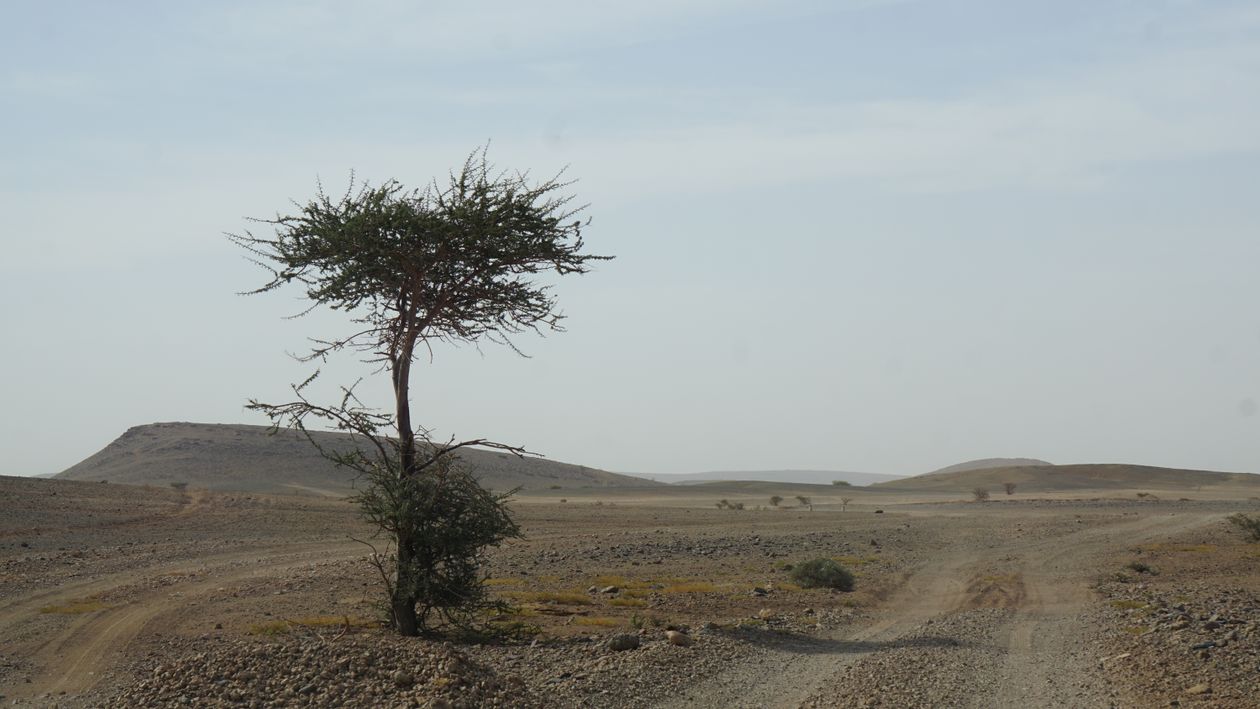
Why does tree selection matter so much in Riyadh landscaping?
Trees are among the longest-lived and most expensive living elements in a landscape. A shrub that performs poorly can often be replaced with limited disruption, while replacing a mature tree can affect shade, visual structure, irrigation layouts, paving, lighting, and the overall design.
Riyadh's landscape environment places strong stress on trees. High solar radiation, hot air temperatures, dry winds, warm paved surfaces, limited rainfall, variable soil quality, and irrigation-water chemistry can all affect establishment and long-term performance.
Selecting a tree that merely survives these conditions is not enough. It should also retain acceptable canopy quality, growth, shade, structure, and visual value without requiring excessive irrigation or constant corrective maintenance.
This is why tree selection is fundamentally a design and asset-management decision, not a nursery-shopping decision.
What does drought tolerance actually mean?
Drought tolerance refers to the ability of a plant to maintain function or recover after periods of limited water availability.
Different species achieve this in different ways. Some develop extensive root systems, some reduce leaf area, some have small or waxy leaves, and others temporarily slow growth during stressful periods.
Drought tolerance does not mean a newly installed tree requires no irrigation. Establishment is a separate stage during which roots must expand beyond the original root ball into the surrounding soil.
A drought-adapted mature tree may eventually require substantially less intervention than a high-water-demand species, but it still needs correct establishment and appropriate monitoring.
Is heat tolerance the same as drought tolerance?
No. The two traits often overlap but are not identical.
A species may tolerate dry soil but suffer leaf scorching, branch damage, or poor growth under extreme reflected heat from paving and walls.
Another species may tolerate high air temperatures when irrigated but decline rapidly if irrigation is interrupted.
For Riyadh projects, selection should therefore evaluate both water stress and thermal stress.
Should every Riyadh landscape use only native trees?
Native trees deserve strong consideration because many are naturally associated with Saudi environmental conditions and can provide ecological and cultural value.
However, “native” should not be used as the only design filter. Saudi Arabia contains very different climatic zones, so a species native to a cool highland or humid southwestern environment is not automatically suitable for Riyadh.
The more useful concept is site adaptation. Evaluate whether the tree's natural environmental range and horticultural behavior match the actual Riyadh site.
Well-adapted non-native trees may sometimes have a role, but they should be evaluated for water demand, invasiveness, root behavior, maintenance, and long-term performance before approval.
Start with function: what does the tree need to do?
Before choosing a species, define the purpose of the tree.
Is it intended to shade a pedestrian path, frame an entrance, screen a service area, provide visual identity, form a windbreak, soften a parking area, create a focal point, or establish a natural desert character?
A tree suitable for an open park may be unsuitable for a narrow sidewalk. A thorny desert species may work well in a broad landscape buffer but be inappropriate directly beside a children's play route.
Functional selection reduces later pruning, removal, and redesign.
| Landscape Function | Priority Trait | Secondary Consideration | Common Mistake |
|---|---|---|---|
| Pedestrian Shade | Useful canopy | Clearance and roots | Choosing only by appearance |
| Entrance Feature | Form and identity | Maintenance consistency | Using a climate-sensitive species |
| Parking Shade | Canopy spread | Litter and roots | Planting in tiny pits |
| Landscape Buffer | Hardiness and density | Wind exposure | Ignoring mature width |
How should full-sun exposure influence tree selection?
Many Riyadh landscapes experience intense direct sunlight for most of the day.
Trees planted in open medians, parking areas, plazas, or large villa gardens may receive substantially more heat than trees protected by buildings during part of the afternoon.
Evaluate how much reflected heat comes from walls, asphalt, stone, and concrete. A site surrounded by hardscape can create a harsher microclimate than an open soil area only a short distance away.
Species selection and planting position should account for this local heat load.
Why should soil be tested before finalizing the tree list?
Trees do not grow in climate alone. They grow in a specific soil profile.
Landscaping sites may contain natural soil, imported fill, construction-compacted layers, alkaline conditions, or highly variable material across the same project.
Soil texture affects drainage and water retention, while compaction influences how easily roots can explore the surrounding area.
A species that tolerates drought may still perform poorly if its roots remain trapped in a poorly drained or heavily compacted planting zone.
How does irrigation-water salinity change tree selection?
Water quality is one of the most important filters in arid-region tree selection.
A drought-tolerant tree is not automatically salt tolerant. These are different physiological challenges.
Where irrigation water contains elevated dissolved salts, species with poor salt tolerance may develop leaf burn, reduced growth, or progressive decline even if irrigation volume appears adequate.
Water analysis should therefore be reviewed together with species tolerance and soil drainage.
Why can a drought-tolerant tree still fail in wet soil?
Many trees adapted to dry environments perform poorly when root zones remain saturated.
Excess water can reduce oxygen around roots and create conditions for root decline.
This is one reason irrigation problems are not always caused by “too little water.” A drought-adapted species can be damaged by excessive or poorly drained irrigation.
Soil profile, grading, drainage, and irrigation design should therefore be coordinated before planting.
How much rooting space does a drought-tolerant tree need?
Drought resilience depends partly on the tree's ability to develop an effective root system.
Installing a potentially large tree inside a very small isolated soil pocket limits its access to water and nutrients regardless of the species label.
Tree pits should be considered as part of a connected rooting environment where possible rather than decorative openings cut through hardscape.
Mature canopy expectations should be matched with realistic below-ground space.
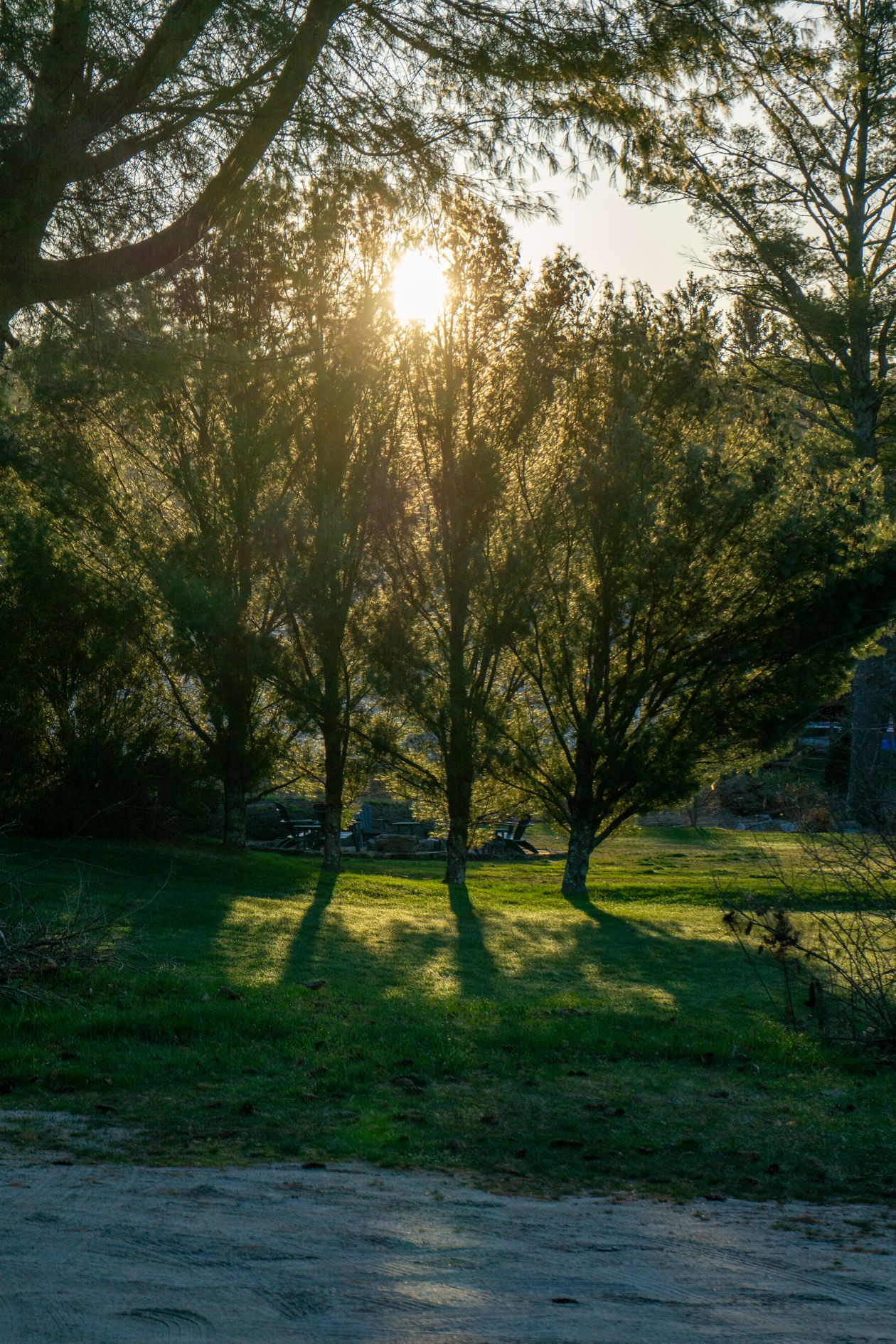
How should canopy goals influence drought-tolerant tree selection?
Not every drought-tolerant tree creates the same quality of shade.
Some desert-adapted species have open, fine-textured canopies that filter sunlight rather than creating dense shade. Others develop broader crowns capable of shading seating areas or walkways.
The designer should define whether the project needs dense pedestrian shade, filtered shade, architectural form, screening, or ecological planting.
Selecting solely on drought tolerance can create a landscape that survives but fails its human-comfort objective.
Why should mature size be checked before planting?
Nursery trees can make a large species look deceptively compact.
The final crown may eventually conflict with buildings, lights, signs, roads, or neighboring trees.
Mature height and width should be considered before determining spacing and planting position.
Repeated heavy pruning later is often a sign that the wrong tree was selected for the available space.
How should roots be considered near paving and structures?
Root behavior depends on species, soil moisture, available oxygen, soil volume, and physical barriers.
Avoid placing large trees into narrow strips directly beside sensitive paving without considering mature root requirements.
Tree selection should be coordinated with adequate setbacks, rooting zones, and landscape details rather than relying on future pruning as the main control strategy.
The objective is to design space for the mature tree from the beginning.
How does wind exposure affect tree selection in Riyadh?
Open sites can experience dry winds that increase water loss from leaves and soil.
Trees with weak branch structure or high wind sensitivity may require more maintenance in exposed areas.
Windbreak zones, site edges, broad road corridors, and open commercial sites should therefore consider structural form as well as drought tolerance.
Species with established performance in harsh exposed environments may be preferable to visually attractive but delicate trees.
What about dust and urban environmental stress?
Urban trees may face dust accumulation, traffic exposure, radiant heat, constrained roots, and maintenance disturbance simultaneously.
Species with delicate foliage or high humidity requirements can struggle even if they technically tolerate Riyadh's temperature range.
The entire urban stress package should be evaluated instead of using maximum temperature alone as the selection criterion.
When can Sidr be considered for Riyadh landscaping?
Sidr is strongly associated with Saudi landscapes and can be an important candidate where the design requires a durable regional character.
Its form can work in gardens, larger landscape areas, naturalistic schemes, and selected public-space applications when sufficient canopy and rooting space are provided.
As with every tree, the exact species or nursery stock should be checked rather than relying only on the common name.
Mature dimensions, thorn characteristics where relevant, placement, and maintenance access should be considered before specifying it beside high-contact pedestrian areas.
Why are Acacia-type trees important in arid landscape design?
Several Acacia and related regional trees are naturally associated with harsh, dry environments and can contribute a strong desert-landscape identity.
They can be useful in naturalistic planting, open spaces, buffers, large sites, and schemes where filtered shade and low-water character are desirable.
However, “Acacia” covers many different species with different mature sizes, forms, thorn characteristics, and environmental ranges.
The botanical identity should therefore be confirmed in procurement specifications.
Where can Ghaf fit into a drought-resilient Riyadh landscape?
Ghaf-type trees are frequently considered for arid-region landscaping because of their association with heat and drought resilience.
They may be useful in larger spaces, natural landscape zones, roadsides, or wind-exposed areas where mature size can be accommodated.
Designers should still review canopy spread, root space, local nursery quality, and exact species identification before approving large quantities.
When is Tamarix useful in Riyadh landscaping?
Tamarix species are associated with harsh environments and can be useful where wind exposure, difficult soils, or regional landscape character are important.
Their use should be planned around the specific site function, available space, appearance, and maintenance expectations.
They are not automatically the right choice for every ornamental location simply because they tolerate difficult conditions.
What role can Arak and Sarh play in regional planting palettes?
Arak and Sarh can contribute to planting palettes designed around regional identity and environmental adaptation.
Depending on the exact species, form, and project context, they may be considered for naturalistic gardens, public landscapes, large open sites, buffers, or other uses where their mature characteristics fit the space.
Availability and nursery quality should be confirmed early because a good species specified on paper is not useful if project-quality stock cannot be sourced.
| Tree Group | Potential Landscape Role | Main Strength | Selection Check |
|---|---|---|---|
| Sidr | Shade / regional identity | Harsh-condition adaptation | Mature size and placement |
| Acacia-type Trees | Naturalistic / buffer | Arid-environment character | Exact species and thorns |
| Ghaf | Open space / landscape structure | Heat and drought resilience | Root and canopy space |
| Tamarix | Exposed / regional landscapes | Harsh-site tolerance | Visual role and space |
| Arak / Sarh | Regional planting palette | Environmental adaptation | Availability and site match |
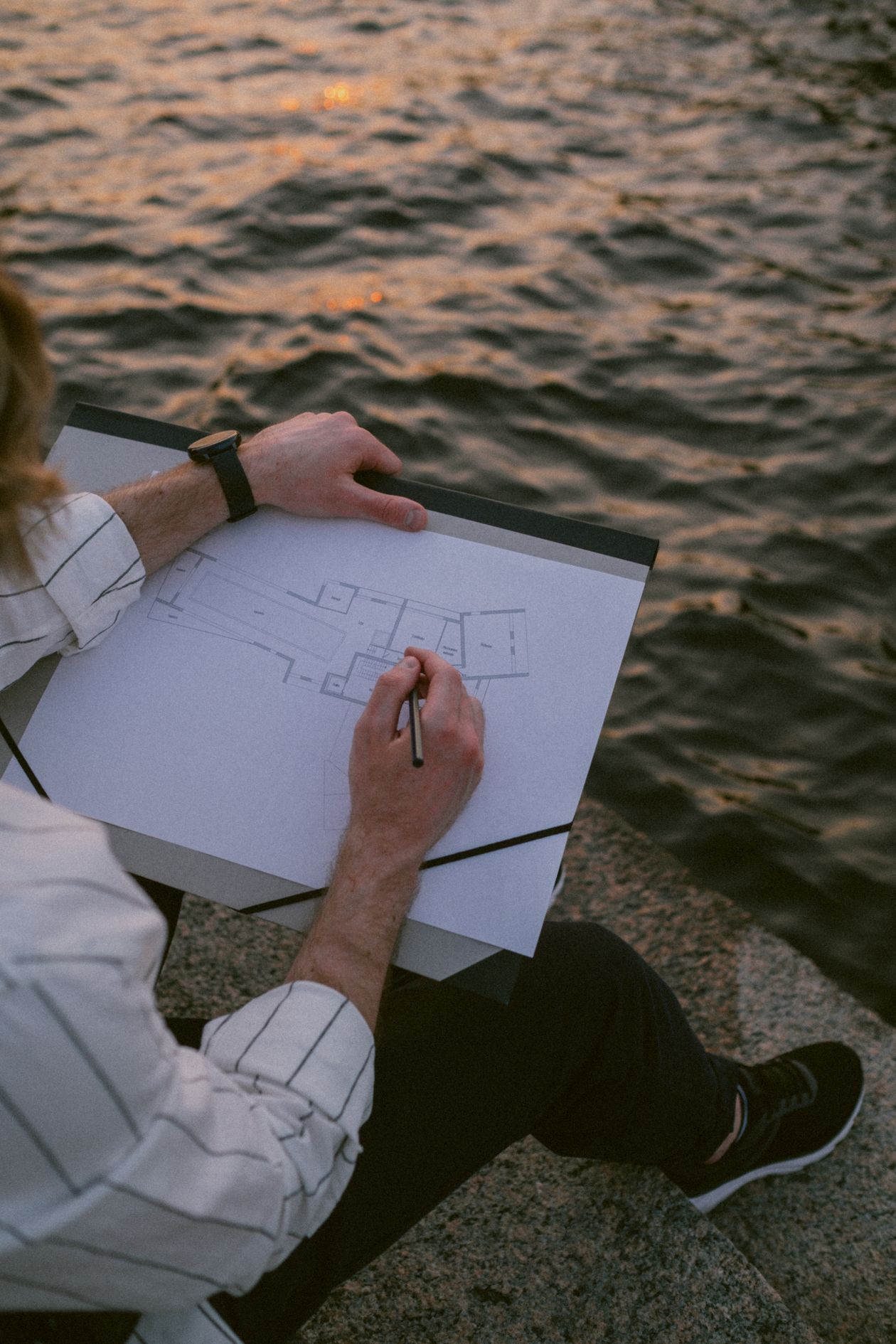
Why should large projects avoid using one tree species everywhere?
A single-species landscape may look visually consistent but can create operational risk.
If that species later proves sensitive to a pest, soil condition, water quality issue, or microclimate, large areas may decline at the same time.
A controlled species mix can improve resilience while maintaining a coherent design language.
Diversity does not mean random planting. Trees can be grouped by landscape zone, function, or visual hierarchy.
How should nursery tree quality be evaluated?
Species selection is only half of procurement. The quality of the actual tree matters.
Inspect trunk structure, branch distribution, signs of mechanical damage, leaf condition, pests, root-ball stability, container condition, and evidence that the tree has been held too long in a small pot.
Avoid selecting only by height. A tall tree with poor roots or weak structure may establish more slowly than a smaller but better-grown specimen.
Nursery inspections should use measurable acceptance criteria wherever possible.
Why is root-system quality critical for drought resilience?
A tree cannot become drought resilient if its roots cannot expand into the surrounding soil.
Severely circling or deformed roots can restrict long-term establishment.
Check whether the root ball is stable but not excessively root-bound, and confirm that the planting process will not bury the trunk flare too deeply.
The objective is to create a tree capable of developing a broad functional root system after installation.
Are very large nursery trees always better?
Not necessarily.
Large trees provide immediate visual impact but are heavier to transport, more difficult to handle, and may experience greater transplant stress.
Smaller high-quality trees can sometimes establish quickly and develop into stronger long-term specimens.
Select nursery size based on project objectives, establishment capacity, logistics, and quality rather than using maximum height as the main purchasing criterion.
How should maintenance capacity influence species selection?
A landscape is not finished on planting day.
Some trees require frequent pruning, cleaning, pest monitoring, fruit or pod cleanup, or structural management.
A project with a small maintenance team should not be filled with species requiring constant attention simply because they look impressive at installation.
Maintenance labor should be considered part of the species-selection decision.
How does the project water budget affect the tree palette?
Define the long-term irrigation philosophy before finalizing tree quantities.
If the objective is a low-water landscape, the tree palette should not be dominated by species that need permanently moist soil or frequent irrigation during summer.
Separate trees into groups with similar long-term water demand where practical.
This prevents one high-water species from forcing the entire irrigation zone to operate at a higher water level.
How can the soil surface support drought-tolerant trees?
Tree performance is affected by what happens above the root zone.
Suitable organic or mineral surface treatments can help protect soil, reduce direct evaporation, control weeds, and improve the visual integration of low-water landscapes.
Avoid piling mulch or soil directly against the trunk.
The tree base should remain inspectable and the root collar should not be buried by decorative material.
Why can one project need several different tree palettes?
A single site can contain very different microclimates.
A west-facing paved entrance may experience extreme afternoon heat, while an internal courtyard may be protected from wind and shaded for part of the day.
A parking edge, building setback, central lawn, and perimeter buffer should not automatically receive the same tree species.
Divide the site into environmental zones and select trees accordingly.
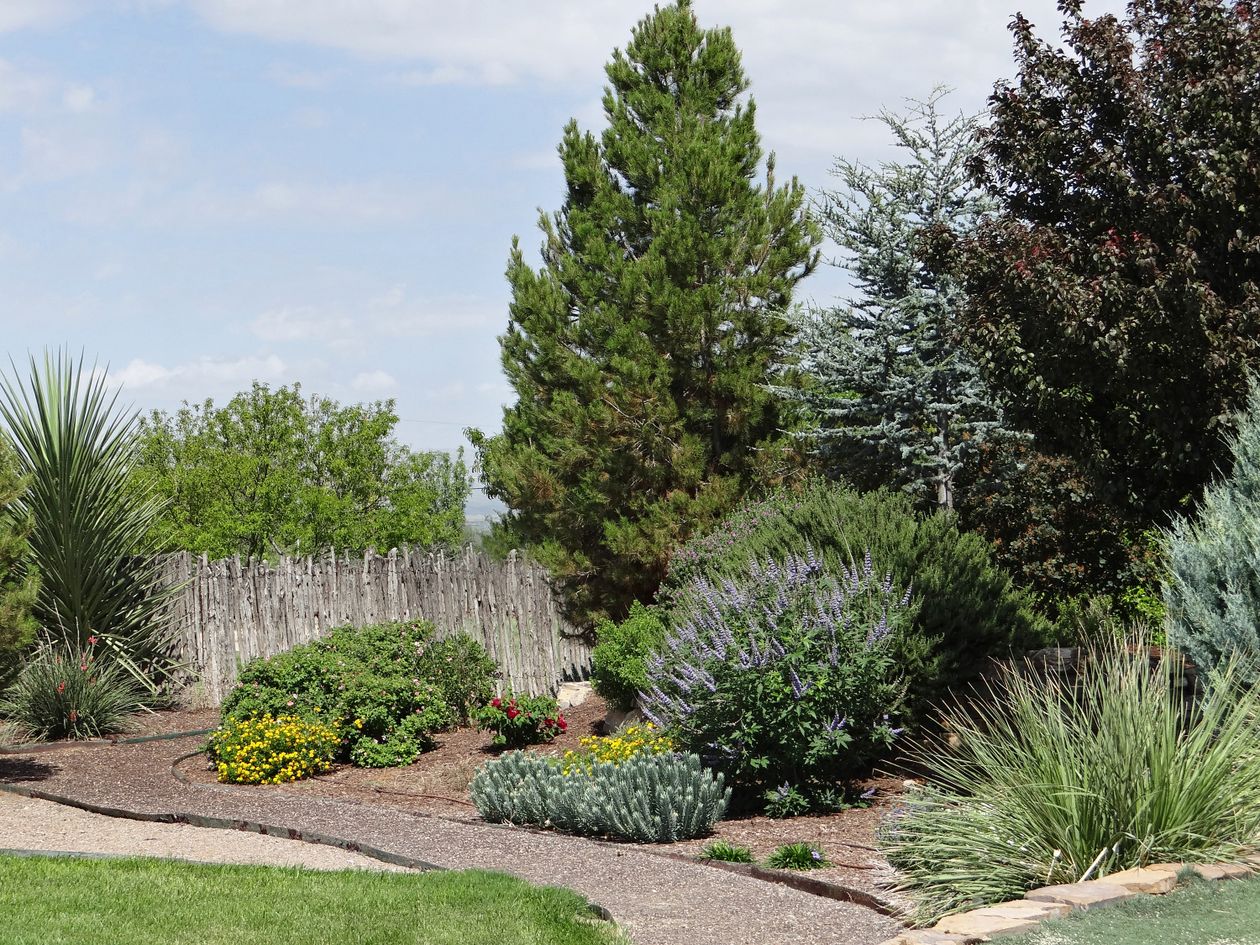
How do you build a practical tree-selection matrix?
Create a table where each candidate tree is scored against project criteria.
Useful columns can include drought tolerance, heat tolerance, salt tolerance, mature height, mature width, shade value, root-space requirement, thorn risk, litter level, maintenance demand, and nursery availability.
Add the intended landscape function so the design team can compare species logically rather than by personal preference.
The matrix does not replace horticultural judgment, but it makes the decision transparent and easier to review.
| Criterion | Why It Matters in Riyadh | Low-Risk Selection | Warning Sign |
|---|---|---|---|
| Heat Tolerance | Long hot periods | Documented hot-climate performance | Needs cool or humid conditions |
| Drought Tolerance | Water conservation | Recovers from controlled water stress | Requires permanently wet soil |
| Salt Tolerance | Water and soil chemistry | Suitable for tested site conditions | Leaf burn under site water quality |
| Mature Size | Avoid future conflicts | Fits available space | Requires permanent heavy pruning |
| Maintenance | Lifecycle cost | Matches maintenance capacity | Frequent intervention required |
What should tree procurement specifications include?
Use the botanical name rather than common name alone.
Define acceptable nursery size, stem structure, canopy condition, root-ball or container condition, general health, pest-free requirements, and rejection criteria.
Where form is important, clarify whether single-stem, multi-stem, or another trained form is required.
Avoid accepting substitutions simply because another tree looks similar when young.
Substitutions should be reviewed against the original function, water demand, mature size, roots, and environmental tolerance.
Planning a Riyadh landscaping project and need a tree palette built around heat, drought, soil, shade, and long-term maintenance rather than appearance alone?
What are the most common mistakes when selecting trees for Riyadh?
The first mistake is selecting trees from photographs without checking environmental suitability.
The second mistake is assuming every tree sold locally is suitable for long-term outdoor performance in Riyadh.
The third mistake is treating heat tolerance and drought tolerance as the same characteristic.
The fourth mistake is assuming drought tolerance means no irrigation during establishment.
The fifth mistake is ignoring irrigation-water quality.
The sixth mistake is failing to review soil drainage.
The seventh mistake is planting large trees into very small soil pockets.
The eighth mistake is selecting trees without considering mature canopy width.
The ninth mistake is planting large-rooting trees directly beside sensitive paving without adequate root space.
The tenth mistake is using thorny species in inappropriate high-contact locations.
The eleventh mistake is selecting dense shade trees where the design actually requires open visibility.
The twelfth mistake is choosing open-canopy desert trees where deep pedestrian shade is essential.
The thirteenth mistake is specifying a native species from a very different Saudi climate without checking Riyadh suitability.
The fourteenth mistake is using one species across an entire large project.
The fifteenth mistake is selecting by nursery height rather than overall tree quality.
The sixteenth mistake is accepting root-bound stock because the canopy looks healthy.
The seventeenth mistake is ignoring maintenance requirements such as litter, pruning, or thorn management.
The eighteenth mistake is failing to coordinate trees with lighting, signage, utilities, and pedestrian circulation.
The nineteenth mistake is accepting substitutions without checking mature behavior.
The twentieth mistake is designing a low-water landscape but specifying a high-water tree palette.
What is the complete checklist for drought-tolerant tree selection?
Climate:
☐ High-temperature tolerance reviewed.
☐ Drought tolerance reviewed separately.
☐ Full-sun exposure assessed.
☐ Reflected heat assessed.
☐ Wind exposure assessed.
Soil:
☐ Soil type understood.
☐ Compaction checked.
☐ Drainage checked.
☐ Rootable soil volume reviewed.
☐ Soil chemistry reviewed where needed.
Water:
☐ Irrigation-water quality known.
☐ Salinity considered.
☐ Long-term water budget defined.
☐ High-water species separated from low-water zones.
Function:
☐ Shade objective defined.
☐ Screening objective defined.
☐ Entrance or focal-point role defined.
☐ Pedestrian clearance considered.
Mature Tree:
☐ Final height reviewed.
☐ Final canopy width reviewed.
☐ Root behavior considered.
☐ Thorn characteristics considered.
☐ Litter considered.
Nursery:
☐ Botanical name confirmed.
☐ Plant health inspected.
☐ Branch structure inspected.
☐ Root system inspected.
☐ Container condition inspected.
Maintenance:
☐ Pruning demand reviewed.
☐ Cleaning demand reviewed.
☐ Pest-monitoring demand reviewed.
☐ Maintenance team capacity considered.
Design Coordination:
☐ Distance from buildings checked.
☐ Distance from paving checked.
☐ Lighting conflicts checked.
☐ Signage conflicts checked.
☐ Underground and overhead services reviewed.
Procurement:
☐ Specification is measurable.
☐ Substitution procedure is defined.
☐ Required quantity is checked against nursery availability.
☐ Alternative suitable species are prepared where necessary.
How does tree selection change across practical Riyadh landscaping scenarios?
Large Villa Garden
A villa can use a mixture of shade trees and smaller regional trees. Large canopy trees should be positioned where they can shade seating areas or major garden zones without conflicting with the building.
Decorative species with higher care requirements can be concentrated near the main residence while lower-water regional trees dominate the broader landscape.
Commercial Entrance
The entrance requires visual consistency, controlled form, clear sightlines, and resilience to reflected heat from paving.
Species that continually require corrective pruning or suffer heat damage can weaken the identity of the entrance over time.
Parking Landscape
Shade is a major objective, but tree pits are often too small.
Select trees with useful canopy potential and provide enough rooting space instead of expecting a large canopy from a small isolated opening in paving.
Public Pedestrian Area
Consider shade, pedestrian clearance, thorn risk, falling material, visibility, irrigation access, and long-term pruning.
The tree should support pedestrian comfort without creating repeated conflicts with the route.
Natural Desert Landscape
Regional trees such as selected Sidr, Acacia-type trees, Ghaf, or other locally appropriate species can support a stronger desert identity.
Planting density should remain compatible with the intended natural character rather than turning drought-adapted trees into a high-density formal plantation.
Corporate Campus
Use several functional palettes: shade trees around pedestrian zones, durable trees along exposed edges, and identity trees at entrances and focal spaces.
A species-diverse but visually coordinated approach can improve long-term resilience.
| Project Zone | Primary Requirement | Selection Priority | Avoid |
|---|---|---|---|
| Villa Garden | Shade + character | Canopy and maintenance balance | Oversized trees beside buildings |
| Commercial Entrance | Consistent identity | Heat resilience and form | Sensitive high-maintenance trees |
| Parking Area | Useful shade | Canopy + adequate roots | Tiny planting pits |
| Desert Landscape | Regional character | Locally adapted palette | High-water ornamental palette |
Frequently Asked Questions About Drought-Tolerant Trees in Riyadh
1. What are the best drought-tolerant trees for Riyadh?
There is no single best species for every site. Sidr, selected Acacia-type trees, Ghaf, Tamarix, Sarh, Arak, and other regionally adapted trees may be considered depending on function, soil, water quality, space, and maintenance requirements.
2. Do drought-tolerant trees need irrigation?
Yes, especially during establishment. Drought tolerance should not be interpreted as zero-water planting.
3. Are native trees always better than imported trees?
Native trees deserve priority evaluation, but the species must be native or adapted to environmental conditions comparable to Riyadh. Saudi Arabia contains several very different climate zones.
4. Does heat tolerance mean a tree can survive with little water?
No. A species may tolerate high air temperature but still require frequent irrigation.
5. Can a drought-tolerant tree die from overwatering?
Yes. Poor drainage and excessive irrigation can damage roots even in species adapted to dry environments.
6. How important is irrigation-water salinity?
Very important. Drought tolerance and salt tolerance are different traits, so water quality should be checked before approving the final species list.
7. Which trees provide the most shade?
Shade performance depends on mature canopy width and density. Some desert trees provide filtered shade while others develop broader crowns.
8. Are Acacia trees suitable for every Riyadh project?
No. Different Acacia-type trees have different sizes, thorn characteristics, forms, and site requirements.
9. Is Sidr suitable for landscaping?
It can be a strong regional candidate where its mature size, form, roots, and placement match the project requirements.
10. Can Ghaf be used in Riyadh projects?
It can be considered for appropriate arid landscape applications, particularly where sufficient space is available and the exact plant material is suitable for the site.
11. Should I choose the largest tree available from the nursery?
Not automatically. Structure, root quality, health, and establishment potential are more important than height alone.
12. Why do some trees fail even when they are drought tolerant?
Common causes include poor nursery stock, compacted soil, insufficient rooting volume, poor drainage, unsuitable irrigation water, incorrect planting depth, or mismatch between species and microclimate.
13. Should tree species be mixed in a large project?
Usually yes. Controlled diversity can improve resilience and allow different species to serve different landscape functions.
14. How many tree species should a project use?
There is no universal number. The right diversity depends on site size, design language, environmental zones, maintenance capacity, and procurement availability.
15. How do I choose trees for parking areas?
Prioritize useful mature canopy, heat tolerance, adequate root space, manageable litter, and compatibility with paving and vehicle circulation.
16. Can trees be selected before soil testing?
A preliminary palette can be prepared, but final selection is stronger when soil and irrigation-water conditions are understood.
17. How do I reduce long-term tree maintenance?
Select species that fit the space at maturity, require limited corrective pruning, match water conditions, and do not create unnecessary conflicts with hardscape or circulation.
18. Is a tree with small leaves always drought tolerant?
No. Leaf size can be one adaptation, but drought performance depends on the entire physiology and rooting behavior of the species.
19. What information should a landscaper collect before recommending trees?
Site location, sun exposure, soil, irrigation-water quality, rooting space, landscape function, nearby structures, maintenance capacity, and desired mature appearance.
20. What is the most important rule for selecting Riyadh landscape trees?
Match the species to the actual site conditions and long-term function rather than selecting by appearance or nursery availability alone.
What is the final approach to selecting drought-tolerant trees for Riyadh?
Begin with the actual site rather than a generic list of drought-tolerant trees.
Define what each tree must do in the landscape.
Evaluate heat tolerance and drought tolerance separately.
Give strong consideration to local and regionally adapted species.
Confirm that a Saudi native species is actually suitable for Riyadh's environmental conditions.
Review full-sun and reflected-heat exposure.
Understand the soil profile before final procurement.
Review irrigation-water quality and salinity.
Avoid poorly drained conditions for dry-climate trees.
Provide realistic rooting volume.
Match canopy type to the required level of shade.
Design for mature height and width rather than nursery size.
Coordinate root space with paving, structures, lighting, and utilities.
Consider wind, dust, and the complete urban microclimate.
Evaluate Sidr, selected Acacia-type trees, Ghaf, Tamarix, Sarh, Arak, and other suitable species according to the specific project conditions rather than using them automatically.
Use more than one species in large projects when a controlled diverse palette improves resilience.
Inspect nursery quality before accepting the plants.
Evaluate roots as carefully as the canopy.
Do not assume that the largest nursery specimen is the best long-term investment.
Match the palette to the maintenance team's real capacity.
Build the species list around the project's long-term water budget.
Divide large projects into microclimate zones.
Use a selection matrix so environmental and operational criteria can be compared clearly.
Write botanical names and measurable nursery specifications into procurement documents.
At Rayat Najd Landscaping & Sustainability, drought-tolerant tree selection is approached as part of the complete landscape system. The process begins with understanding the site's climate, soil, irrigation water, sun exposure, landscape function, and available root space, then comparing suitable tree species according to mature size, shade value, environmental tolerance, maintenance demand, and nursery quality. The objective is to build Riyadh landscapes that remain visually strong and operationally realistic under demanding local conditions instead of relying on short-term appearance at the time of planting.
الوسوم # أشجار الرياض # أشجار تتحمل الجفاف
This post is part of a series called Post